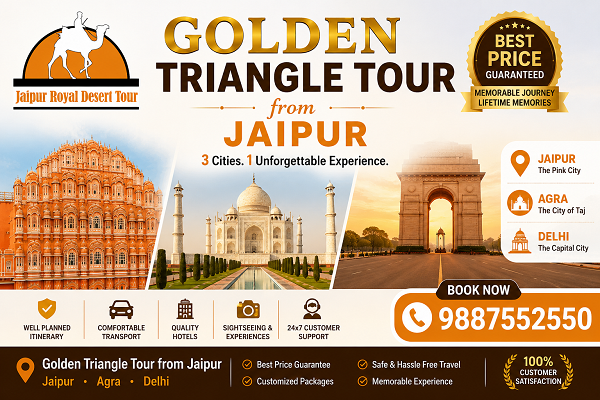
Golden Triangle Tour from Jaipur
India's Golden Triangle is the country's most celebrated travel circuit, linking three cities that together tell the story of Mughal grandeur, Rajput valor, and modern Indian life. While most travelers begin in Delhi, starting the Golden Triangle Tour from Jaipur has quietly become the preferred route for a growing number of visitors — especially those flying into Jaipur directly, those who want to ease into the trip with the relatively relaxed pace of the Pink City, or those building a longer Rajasthan itinerary that naturally concludes in Agra and Delhi. This guide walks through every part of planning and experiencing a Golden Triangle Tour that begins in Jaipur, from the best day-by-day itinerary to transport options, costs, packing advice, and insider tips gathered from years of travel writing on this route.
Why Start the Golden Triangle from Jaipur
The classic Golden Triangle route is usually presented as Delhi–Agra–Jaipur–Delhi, since Delhi is India's primary international gateway. But a Jaipur-first itinerary has real advantages. Jaipur International Airport has grown steadily and now connects to several domestic hubs and a handful of international routes, making it a viable entry point for travelers already in Rajasthan or arriving via a connecting flight. Starting in Jaipur also means you begin the trip with a city that is colorful, walkable, and gentle on jet lag — wide boulevards, manageable traffic compared to Delhi, and a slower introduction to Indian street life before the intensity of Agra's tourist crowds and Delhi's scale.
There is also a narrative logic to the Jaipur-first route. You begin with Rajput history and architecture in the Pink City, move to Mughal romance and tragedy at the Taj Mahal in Agra, and finish in Delhi, where ancient monuments sit beside colonial government buildings and a thoroughly modern capital. Ending in Delhi is also practical: it is the easiest city from which to catch an onward international flight or continue traveling elsewhere in India.
Quick summary: The Golden Triangle from Jaipur typically covers Jaipur, Fatehpur Sikri, Agra, and Delhi over 5 to 7 days, combining UNESCO World Heritage Sites including Amber Fort, the Taj Mahal, Agra Fort, Humayun's Tomb, and Qutub Minar.
Golden Triangle Overview: The Three Cities
Each city on the Golden Triangle offers a distinct flavor of India's layered history, and understanding what makes each one special helps you plan how much time to allocate.
Jaipur — The Pink City
Founded in 1727 by Maharaja Sawai Jai Singh II, Jaipur was one of the first planned cities in India, laid out according to principles of Vastu Shastra and organized into nine rectangular blocks. The old city was painted pink in 1876 to welcome the Prince of Wales, and the tradition has been maintained ever since, giving Jaipur its enduring nickname. The city blends Rajput military architecture — forts perched on rocky hills — with ornate palaces, bustling bazaars selling textiles and gemstones, and a food culture built around rich, ghee-laden Rajasthani cuisine.
Agra — City of the Taj
Agra served as the capital of the Mughal Empire for over a century and is home to three UNESCO World Heritage Sites within a short distance of each other: the Taj Mahal, Agra Fort, and the nearby ghost city of Fatehpur Sikri. While Agra itself is a relatively chaotic, industrial city, its monuments are some of the finest examples of Mughal architecture anywhere in the world, built from white marble and red sandstone with intricate inlay work.
Delhi — Capital of Contrasts
Delhi is really two cities in one. Old Delhi, once the Mughal capital of Shahjahanabad, is a maze of narrow lanes, spice markets, and centuries-old mosques. New Delhi, designed by British architects Edwin Lutyens and Herbert Baker in the early twentieth century, is a city of wide avenues, government buildings, and embassies. Together they offer everything from the Red Fort and Jama Masjid to India Gate and the Lotus Temple, making Delhi the most architecturally diverse stop on the circuit.
Day-by-Day Itinerary
The ideal length for a Golden Triangle Tour from Jaipur is five to seven days. Below is a detailed six-day itinerary that balances sightseeing with rest, followed by notes on how to compress it to five days or extend it to seven or more.
Day 1: Arrival and Jaipur City Exploration
Arrive in Jaipur and check into your hotel. Spend the afternoon exploring the City Palace, a sprawling complex that remains partly home to the former royal family, and the adjoining Jantar Mantar, an eighteenth-century astronomical observatory with giant stone instruments that still tell time and track celestial movements with remarkable accuracy. End the day at Hawa Mahal, the five-story "Palace of Winds," ideally photographed at sunset or early the next morning from the rooftop cafe across the street.
Day 2: Amber Fort and Jaipur Bazaars
Devote the morning to Amber Fort, the hilltop fortress-palace nine miles from central Jaipur, famous for its Sheesh Mahal (Mirror Palace) where thousands of tiny mirrors create a glittering effect from candlelight. Many travelers choose to ride up via jeep rather than elephant, given growing concerns about elephant welfare at the site. In the afternoon, visit Nahargarh Fort for panoramic views over the city, then spend the evening wandering Johari Bazaar and Bapu Bazaar for jewelry, block-printed textiles, and leather juttis (traditional shoes).
Day 3: Drive from Jaipur to Agra via Fatehpur Sikri
Depart Jaipur early for the roughly five-to-six-hour drive to Agra. Break the journey at Fatehpur Sikri, the abandoned Mughal capital built by Emperor Akbar in the sixteenth century and deserted within decades due to water shortages. The complex, remarkably well preserved, includes the Buland Darwaza (one of the largest gateways in the world), the Jama Masjid, and the tomb of Sufi saint Salim Chishti. Continue to Agra and settle in for the evening.
Day 4: Taj Mahal at Sunrise and Agra Fort
This is the heart of the trip. Arrive at the Taj Mahal gates before sunrise to beat both the heat and the crowds; the early light on the white marble is widely considered the best time to see the monument. Spend the late morning at Agra Fort, the red sandstone fortress from which Shah Jahan, the Taj's builder, was later imprisoned by his son with a view of the monument he built for his wife. In the afternoon, depart for Delhi, a three-to-four-hour drive, or take the faster Gatimaan Express train, which covers the distance in under two hours.
Day 5: Old Delhi
Spend the day exploring Old Delhi. Visit the Red Fort, the Mughal seat of power for over two centuries, then walk or take a cycle rickshaw through Chandni Chowk, the historic market street, ending at Jama Masjid, India's largest mosque. In the afternoon, explore the spice market at Khari Baoli or sample street food specialties like paranthas at Paranthe Wali Gali.
Day 6: New Delhi and Departure
Spend the morning in New Delhi visiting Humayun's Tomb, a precursor to the Taj Mahal's architectural style and a UNESCO World Heritage Site in its own right, followed by Qutub Minar, the tallest brick minaret in the world. Drive past India Gate and the President's House (Rashtrapati Bhavan) before a final stop at the Lotus Temple or Akshardham Temple if time allows. Depart from Delhi in the evening, or extend your stay for further exploration.
Five-day version: Combine Days 1 and 2 into a single, fuller day in Jaipur, or skip Nahargarh Fort. Seven-day-plus version: Add a half-day in Jaipur for a cooking class or block-printing workshop, or extend Delhi by a day to include Akshardham Temple and a day trip to Gurgaon or a heritage walk in Mehrauli.
Exploring Jaipur in Depth
Jaipur rewards travelers who slow down rather than rush between monuments. Beyond the headline sites, the city's character lives in its bazaars and craft traditions. Johari Bazaar has been a center of the Indian jewelry trade for centuries and remains one of the best places in the country to see gem cutting and traditional Kundan and Meenakari jewelry-making. Sanganeri and Bagru villages on the outskirts of the city are the source of Jaipur's famous block-printed textiles, and several workshops welcome visitors to watch the printing process firsthand. With JRD Tours, travelers can experience these cultural highlights in a more meaningful and well-organized way, ensuring they don’t just visit Jaipur but truly understand its living heritage.
Food in Jaipur leans rich and vegetarian-friendly, reflecting Rajasthan's historically arid climate and the Marwari merchant traditions that shaped much of the state's cuisine. Dal baati churma, a dish of baked wheat balls served with lentils and a sweet crumble, is the most iconic regional specialty. Laxmi Mishthan Bhandar, a Jaipur institution since 1727, is a popular spot to sample both savory snacks and traditional Rajasthani sweets.
For those interested in textiles and crafts, the Anokhi Museum of Hand Printing, set inside a restored haveli in Amber, offers a more curated look at the block-printing tradition with demonstrations and a small but excellent shop.
Exploring Agra and the Taj Mahal
The Taj Mahal was commissioned by Mughal emperor Shah Jahan in 1632 as a mausoleum for his favorite wife, Mumtaz Mahal, who died during childbirth. It took an estimated 20,000 artisans more than two decades to complete, and the white marble was sourced from Makrana in Rajasthan, with semi-precious stones inlaid for decoration brought from as far as Afghanistan, Tibet, and Sri Lanka. The monument is widely regarded as the finest example of Mughal architecture and one of the most photographed buildings on Earth.
Visitors should know that the Taj Mahal is closed on Fridays, and tickets are sold in limited time-slots to manage crowding, so booking in advance through the official ASI (Archaeological Survey of India) ticketing portal is strongly recommended, particularly during peak season from October through March. Security is strict; bags above a certain size, food, and certain electronics are not permitted inside, so travel light.
Agra Fort, sometimes called the Red Fort of Agra to distinguish it from Delhi's Red Fort, predates the Taj Mahal and served as the primary residence of Mughal emperors until the capital moved to Delhi. Its most poignant feature is Musamman Burj, the octagonal tower where Shah Jahan was held under house arrest by his son Aurangzeb for the final years of his life, reportedly gazing at the Taj Mahal from his window.
Exploring Delhi
Delhi's history spans more than a thousand years and at least seven distinct historical cities layered on top of one another, from the Tomar Rajput city of Lal Kot to the British-built New Delhi of the 1930s. This depth is what makes Delhi worth more time than many itineraries allow.
The Red Fort, built by Shah Jahan after he moved the Mughal capital from Agra, is where India's Prime Minister delivers the Independence Day address each year from its ramparts. Nearby, Jama Masjid can accommodate up to 25,000 worshippers and remains an active mosque, so modest dress is required and visitors should check prayer times before visiting.
Humayun's Tomb, built in the 1560s, was the first garden-tomb in the Indian subcontinent and directly influenced the design of the Taj Mahal nearly a century later. Its char-bagh (four-part) Persian garden layout and red sandstone-and-marble construction make it an essential, if often overlooked, stop. Qutub Minar, begun in 1192, is a 240-foot minaret of fluted red sandstone and marble, surrounded by a complex of ruins including the Iron Pillar, whose rust-resistant composition has puzzled metallurgists for decades.
New Delhi's colonial-era core, centered on Rajpath (now Kartavya Path), India Gate, and Rashtrapati Bhavan, offers a completely different architectural register, while the Lotus Temple and Akshardham Temple represent modern India's continuing tradition of ambitious religious architecture.
How to Travel Between the Cities
There are three main ways to travel the Jaipur–Agra–Delhi circuit, each with different tradeoffs in cost, comfort, and time.
| Route | Mode | Approx. Duration | Notes |
|---|---|---|---|
| Jaipur to Agra | Private car/driver | 5–6 hours | Most flexible; allows stop at Fatehpur Sikri |
| Jaipur to Agra | Train | 4–5 hours | Fewer direct trains; limited schedule |
| Agra to Delhi | Gatimaan Express (train) | ~1 hr 40 min | India's fastest train; book ahead |
| Agra to Delhi | Private car/driver | 3–4 hours | Via Yamuna Expressway |
| Within cities | Auto-rickshaw, app-based cabs (Ola/Uber) | Varies | Widely available in all three cities |
Most travelers booking a Golden Triangle Tour, whether independently or through a tour operator, opt for a private car with driver for the inter-city legs. This is the most common and practical choice because it allows for stops at Fatehpur Sikri and roadside dhabas (local eateries), offers door-to-door convenience, and avoids the unpredictability of train schedules on routes with limited daily departures. Costs for a private car with driver across the full circuit typically run from roughly 8,000 to 15,000 Indian rupees depending on the vehicle category and number of days, though this varies with fuel prices and season.
Best Time to Visit
The Golden Triangle is best visited between October and March, when daytime temperatures across Rajasthan, Uttar Pradesh, and Delhi are comfortable for sightseeing, generally ranging from the mid-60s to low-80s Fahrenheit. December and January can bring chilly mornings and occasional dense fog, particularly in Delhi and Agra, which has on rare occasions delayed flights and obscured early Taj Mahal views, so layering is wise.
April through June brings intense heat across the region, with Jaipur and Agra regularly exceeding 104°F (40°C), making outdoor sightseeing exhausting and best limited to early morning and evening hours. The monsoon season from July to September brings humidity and unpredictable rain but also lush landscapes and significantly fewer tourists, which appeals to some travelers willing to trade comfort for lower prices and quieter monuments.
Budget and Costs
Costs for a Golden Triangle Tour from Jaipur vary enormously depending on travel style. The figures below offer a general framework in US dollars for a six-day trip for two travelers, though prices fluctuate with season and currency exchange rates.
| Category | Budget | Mid-range | Luxury |
|---|---|---|---|
| Accommodation (per night, per room) | $15–30 | $60–120 | $200+ |
| Private car with driver (6 days) | $150–300 total | ||
| Monument entry fees (foreigners) | $40–60 per person total | ||
| Meals (per day, per person) | $5–10 | $15–25 | $40+ |
| Guides (optional, per city) | $15–25 per half-day | ||
Entry fees for foreign nationals at major monuments are significantly higher than for Indian citizens, a common practice across heritage sites in India. The Taj Mahal, for instance, carries one of the higher entry fees on the circuit, with an additional charge for entry to the inner mausoleum chamber. It's worth checking current pricing on the official ASI website before traveling, since fees are periodically revised.
Where to Stay
Each city on the circuit offers accommodation across every budget tier, but a few patterns are worth knowing. In Jaipur, staying near the old walled city puts you within walking distance of Hawa Mahal and the bazaars, while heritage hotels converted from former havelis or royal residences offer a particularly atmospheric stay, often at surprisingly reasonable mid-range prices. In Agra, hotels with Taj Mahal views from rooftop restaurants are popular but tend to be priced at a premium; staying slightly further from the monument and taking an early auto-rickshaw to the gates is often more economical without sacrificing much convenience. In Delhi, the choice generally comes down to staying near Connaught Place and New Delhi's government district for central access to New Delhi sights, or near Paharganj or Old Delhi for proximity to the Red Fort and Chandni Chowk, with the tradeoff being a busier, more chaotic immediate neighborhood.
Food to Try Along the Way
Each city contributes distinct culinary traditions to the trip. In Jaipur, beyond dal baati churma, look for pyaaz kachori (a flaky, spiced onion-stuffed pastry), ghewar (a disc-shaped sweet soaked in syrup, especially popular during festival season), and lassi from Lassiwala on Mirza Ismail Road, a stall that has been serving the city since the 1940s. In Agra, the city is famous for petha, a translucent, sugar-syrup-soaked sweet made from ash gourd, sold in countless varieties and flavors throughout the old city. In Delhi, Old Delhi's food lanes are legendary: try parathas stuffed with everything from potato to paneer at Paranthe Wali Gali, kebabs at Karim's near Jama Masjid, and chaat (savory street snacks) at Chandni Chowk stalls. Across all three cities, chai from roadside stalls remains one of the simplest and most consistently satisfying experiences of the trip.
Practical Tips and Etiquette
- Dress modestly at religious sites, covering shoulders and knees; carry a scarf for impromptu mosque or temple visits.
- Remove shoes before entering temples and some palace interiors; wearing slip-on shoes simplifies this throughout the day.
- Bargain respectfully in bazaars, where initial prices for tourists are often inflated; aim for a friendly back-and-forth rather than aggressive haggling.
- Carry cash in smaller denominations for tips, rickshaws, and smaller vendors, though digital payment via UPI apps is increasingly common even at small shops.
- Stay hydrated and drink only bottled or filtered water; avoid ice in drinks from unfamiliar vendors.
- Book Taj Mahal tickets online in advance through the official ASI portal to avoid long queues and guarantee entry during your preferred time slot.
- Hire licensed guides at major monuments rather than accepting offers from unofficial touts who may charge inflated, unregulated rates.
- Use sunscreen and a hat even in cooler months, since much of the sightseeing involves walking across open, sun-exposed courtyards.
- Respect photography restrictions inside certain palace rooms and at the Taj Mahal's inner chamber, where cameras are not permitted.
"The Golden Triangle isn't just a checklist of monuments — it's a journey through nearly a thousand years of Indian history compressed into a few hundred kilometers, from Rajput hill forts to Mughal mausoleums to the architecture of a modern republic."
Extending the Trip
Travelers with additional time often extend the Golden Triangle in one of a few directions. Adding Ranthambore National Park, roughly four hours from Jaipur, allows for a wildlife safari in search of Bengal tigers and fits naturally before or after the Jaipur leg. Alternatively, extending westward to Jodhpur and Udaipur — sometimes called the "Golden Triangle Plus" or expanded Rajasthan circuit — adds the Blue City's Mehrangarh Fort and Udaipur's lake palaces to the itinerary, typically requiring four to five additional days. Travelers continuing on from Delhi sometimes add Varanasi for its ghats and religious significance along the Ganges, reachable by a short flight.
Frequently Asked Questions
How many days do I need for a Golden Triangle Tour from Jaipur?
Most travelers find five to seven days ideal. Five days allows a fast-paced but complete tour of the major sites; seven days allows a more relaxed pace with time for shopping, workshops, and rest days.
Is it better to start the Golden Triangle in Jaipur or Delhi?
Both work well, and the choice usually comes down to flight logistics. Starting in Jaipur suits travelers flying directly into Jaipur or already in Rajasthan, and offers a gentler introduction to India before the larger scale of Delhi. Starting in Delhi suits travelers arriving on international flights into Delhi's larger airport.
Can I do the Golden Triangle Tour independently, or do I need a guide?
Both options are common and viable. Independent travel is straightforward given good road infrastructure, widely available private drivers, and English-speaking guides at every major site, while guided tours offer convenience and deeper historical context, particularly valuable at complex sites like Fatehpur Sikri and Agra Fort.
Is the Golden Triangle Tour safe for solo travelers?
Yes, the route is one of the most heavily traveled and tourist-equipped circuits in India, with well-established infrastructure. As with travel anywhere, standard precautions apply: use reputable transport, avoid isolated areas late at night, and stay alert in crowded markets where pickpocketing can occur.
What is the best time of day to visit the Taj Mahal?
Sunrise is widely considered the best time, both for the soft light on the white marble and for avoiding the largest crowds, which build steadily through the late morning and afternoon.
Do I need separate visas or permits for Rajasthan, Uttar Pradesh, and Delhi?
No. A standard Indian tourist visa covers travel across all Indian states, including the three covered in the Golden Triangle. No additional state-level permits are required for these

